

Radar Sensing
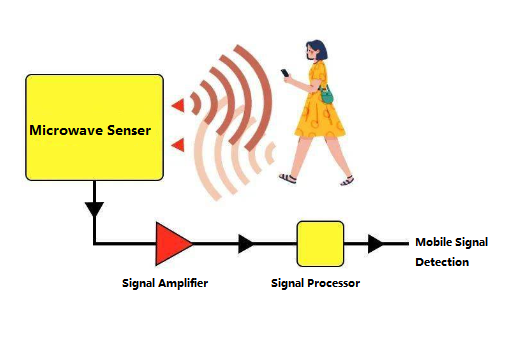
Definition: Radar sensing utilizes microwaves (typically in the 24GHz or 60GHz frequency bands) to detect the movement of objects. It works by emitting microwave signals and receiving the reflected signals to determine the position, speed, and direction of a target. The sensing principle of radar-based lighting is based on the Doppler effect, where radar signals are transmitted and received in a 360° range. Radar sensors have a long detection range, typically reaching up to 8 meters, with a wide angle and high sensitivity. They have the ability to penetrate non-metallic substances and do not require an exposed sensing probe, providing better concealment compared to infrared and sound control sensors. They are not affected by environmental factors such as temperature, dust, and light conditions.
Applications: Suitable for automatic doors, garage doors, security systems, and traffic detection, as well as other scenarios where it can penetrate certain non-metallic objects (such as glass or thin walls).
Characteristics:
Wide detection range and strong penetration capability.
Not sensitive to environmental light or temperature.
Can detect moving objects but may have difficulty distinguishing between humans and stationary targets.
Radar sensing generally has a detection distance of about 8 meters, which is relatively farther than human body sensing.
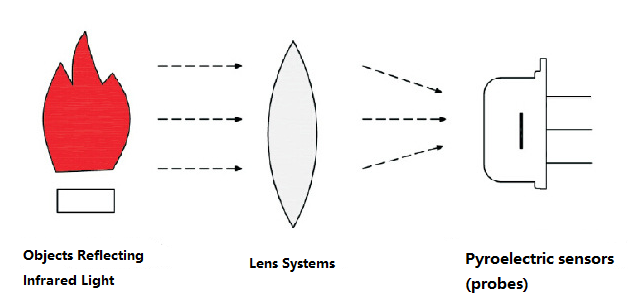
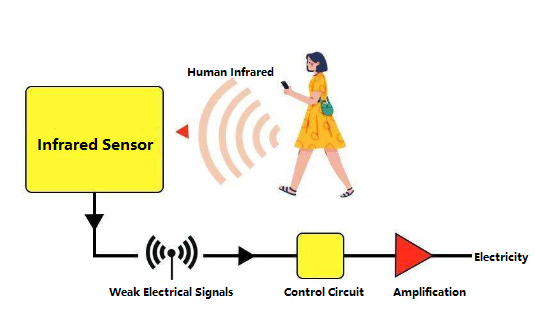
Definition: Human body sensing lights work by using pyroelectric elements to receive infrared radiation emitted by the human body. They detect environmental or human temperature changes through exposed lenses (since the human body has a constant temperature, it emits infrared radiation at a specific wavelength) to trigger subsequent circuit actions. The sensing range is generally limited with a narrow angle and is more susceptible to environmental factors such as temperature and dust, which can result in frequent false triggers. The infrared sensing head also needs to be exposed, making installation less convenient. Human body sensing is specifically designed to detect the presence and movement of humans, with common technologies including Passive Infrared (PIR), microwave sensing, and ultrasonic sensing.
Applications: Widely used in smart homes, lighting systems, and similar scenarios.
Characteristics:
Accurately identifies humans, especially for detecting moving people.
Generally does not penetrate walls or other obstacles (especially passive infrared).
Can distinguish humans from other objects, making it more energy-efficient and intelligent.
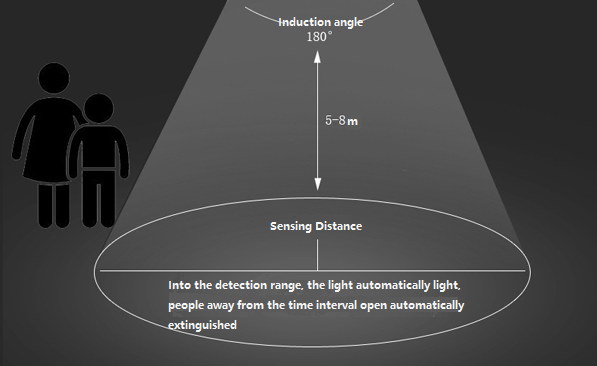
Human body sensing typically has a detection range of 120 to 140 degrees and a detection distance of 4 to 6 meters.
Drawbacks: When the ambient temperature is close to the human body temperature, especially in summer, infrared sensors may become less responsive, with a shorter detection range or even no detection at all. This often results in situations where the light does not turn on when a person arrives but activates after they pass by, leading to unsatisfactory performance.
In daily smart living, a common phenomenon we encounter is that when we remain relatively still, automatic sensor lights turn off. When we make a second movement, the lights turn back on. This issue arises because the sensor cannot detect a stationary human body. A "human presence sensor" can solve this problem by detecting a stationary person. In fact, a "human presence sensor" is a millimeter-wave radar sensor that can precisely detect and locate vital signs and monitor a person's static state, accurately determining whether someone is present in a scene.
Presence Sensing
Definition: Presence sensing is used to detect whether objects are present in an environment, including both stationary and moving objects. The technologies used can include infrared, ultrasonic, radar, or other sensors.
Applications: Suitable for indoor lighting control, office area automation, air conditioning energy-saving control, etc. In public restrooms and kitchens, presence sensing is used to control faucets, automatic flushing systems, hand dryers, and other equipment.
Characteristics:
Can detect both moving and stationary targets.
Can be used to determine whether someone is in a room.
Suitable for scenarios that require continuous detection of the presence of targets.
Differences among the three types of sensing (Radar, Human Body, Presence Sensing)
The main differences lie in the sensing principle, sensing distance, application scenarios, and technical characteristics.
Key Differences:
Detection Target: Radar sensing focuses on detecting moving targets, while presence sensing focuses on whether a target exists (stationary or moving). Human body sensing is specifically for detecting humans.
Technical Principle: Radar sensing relies on microwave technology, while presence sensing and human body sensing can combine various technologies (infrared, ultrasonic, microwave, etc.).
Application Scenarios: Radar sensing is suitable for outdoor and penetrating detection, presence sensing is ideal for indoor scenarios that require detection of stationary objects, and human body sensing is mainly for scenarios related to human activity.
Sensing Distance:
Radar Sensing: Generally has a range of about 8 meters and covers a 360-degree angle, which is farther than human body sensing.
Human Body Sensing: Typically has a detection range of 120 to 140 degrees and a distance of 4 to 6 meters.
Sensitivity:
Radar Sensing: Highly sensitive and minimally affected by external factors such as temperature.
Infrared Sensing: High sensitivity but significantly affected by environmental factors such as temperature and dust.
Technical Characteristics:
Radar Sensing: Can penetrate non-metallic objects, allowing radar sensors to be integrated inside lighting fixtures, making them appear as regular LED tubes while actually having radar sensing capabilities.
Human Body Sensing: Requires the sensing receiver to be exposed to collect infrared energy changes in the environment.