

If Your Lighting Flickers, Take a Look at This
Health-conscious lighting is becoming more and more important, and many businesses advertise "no blue light hazard" and "flicker-free". So, what exactly is flicker?
Q: What is flicker?
A: Flicker occurs when the light emitted by a light source changes at a certain frequency and cycle over time, causing variations in brightness and color. If the driver of the lighting fixture does not have the proper electronic circuits, such as a ballast, driver, or power supply, the light source will produce flicker. The greater the fluctuation in light output, the more severe the flicker.
Q: What is flicker related to?
A: Flicker is influenced by factors such as the power supply, the performance of the light source technology, and improper lighting design. For many lighting fixtures, the current flowing through the light source inevitably fluctuates with the input voltage, which directly leads to fluctuations in light output and causes flicker. For example, in incandescent lamps, the driver uses 50Hz AC power, and the flicker frequency is 100Hz due to the combination of the negative and positive half cycles. Similarly, for gas discharge lamps using inductive ballasts, the output light frequency fluctuates with the supply frequency. Furthermore, the instantaneous fluctuations in the power grid can range from 10% to 20%, which intensifies the light fluctuations in lighting fixtures. Not all flicker is harmful-some forms of flickering are desirable in certain situations.
Examples of Desirable Flicker:
Emergency vehicle lights (ambulances, fire trucks, and police cars).
Wing lights on aircraft during landing.
Laser lights at concerts or in bars.
LED lights with specific flicker frequencies can help treat Alzheimer's disease.
Harmful Flicker
However, flicker can often be harmful:
Low-frequency flickering light sources (3-70Hz) may trigger photosensitive epilepsy in some individuals.
Flickering light sources at 100Hz can cause headaches or migraines.
Flickering light sources at 120Hz can affect mood, leading to irritation, anxiety, etc.
The visual illusion caused by flicker is also dangerous in industrial settings.
Classification of Flicker Levels
In China, standards for flicker in lighting have been established. According to the CQC1601-2016 "Visual Task Lamp Certification Technical Specifications" (implemented on November 2, 2016), flicker must comply with the IEEE Std1789-2015 standard set by the Institute of Electrical and Electronics Engineers (IEEE).
In a document published in 2015, IEEE classified the risk of flickerscopic light into several levels, as shown in the figure:
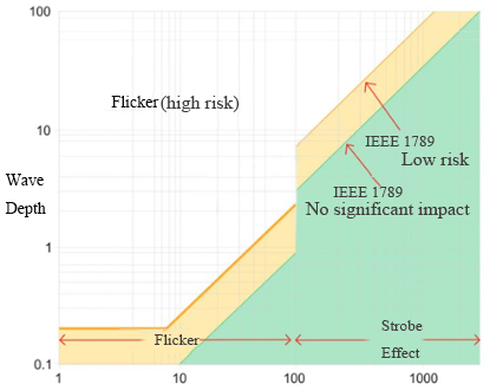
The green area covers the non-hazardous level, while the yellow area is low risk, and anything beyond the yellow part (white area) is unacceptable.
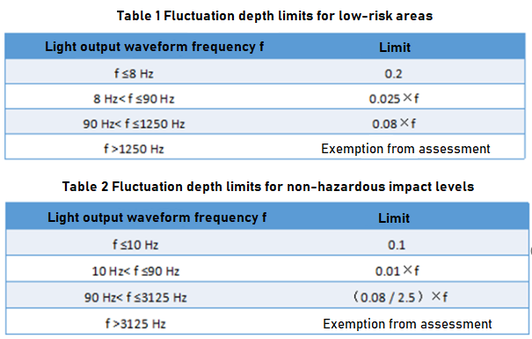
Limit value of luminaire flicker percentage (fluctuation depth) in non-hazardous areas
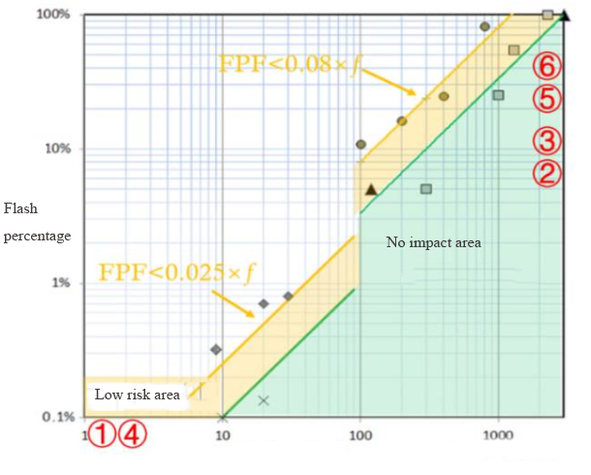
When not dimming, the flicker is almost zero. When dimming, the driver uses 2K Hz high-frequency modulation, and the data falls in the unaffected area, which can be called "no flicker"
How to detect flicker?
Many people want to detect whether the lamp has flicker when buying LED lamps, but they don't know how to detect it? It doesn't matter, here is a simple and practical method to teach you
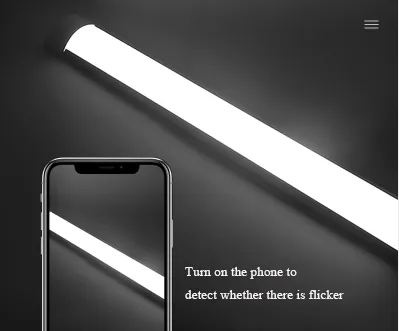
Mobile phone camera detection method (rapid initial screening)
Steps: 1. Open the mobile phone camera and aim at the lamp (turn off AI optimization or filter).
Observe the screen: No flicker: the picture is stable and there is no fluctuation.
There is flicker: flickering stripes or light and dark fluctuations (such as wavy, rolling black bars) appear on the screen.
Detection with mobile phone camera: useful, but not scientific.
In addition, we can also use some professional lighting tools to measure.
Professional tool detection (precise measurement)
Stroboscope/photometer: Directly measure the flicker percentage (%) and flicker index (Flicker Index). Healthy lamps generally require: Flicker percentage <5% (low risk)
Flicker index <0.1 (excellent)
Oscilloscope: Connect the photosensitive sensor and observe the fluctuation of the light waveform (professional operation is required).
How to reduce flicker
To reduce or eliminate the flicker of lamps, you can start from the selection of lamps, circuit optimization, usage habits, etc.
"Flicker" is not a derogatory term. At present, almost all urban electricity provided by power stations is AC. The principle of AC power generation determines that it has periodicity, 50 or 60 cycles per second, which leads to the flicker phenomenon of lamps. From the principle of light emission, the existence of flicker depends on the LED driving circuit. Manufacturers have proposed a variety of solutions to solve this problem: common ones include optimizing circuit design to minimize the flicker frequency. Driver products on the market consider factors such as driving cost, size, reliability, efficiency, etc., so that manufacturers and industry experts can find a flicker level that people can accept.
For more information on dimming, please visit:www.jusinpower.com.