

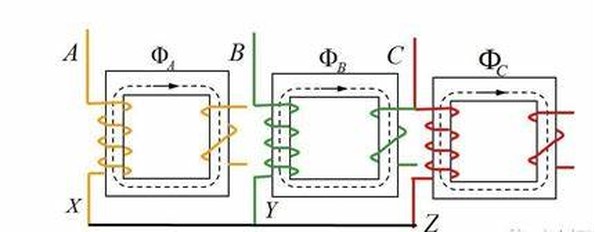
Power transformers are one of the most common and important electronic components, but there are few introductions to the series and parallel use of power transformers in electronic publications. Here is a brief introduction to the series and parallel use of power transformers.
Power transformers are the same as general devices. In emergency work, multiple transformers can be used in series and parallel under certain conditions. For example, commercially available power transformers can fully meet the requirements. When the transformer power meets the requirements, but there is no suitable voltage, two or more transformers can be used in series; when the voltage meets the conditions, but the transformer power is insufficient, two or more transformers can be used in parallel to meet the power supply requirements of the circuit. The power transformer is composed of an inductor coil, so it completely follows the operation rules of the inductor. The primary of the power transformer can be connected in series, or the secondary of the output can be connected in series... The four situations are introduced as follows.
1. Primary series connection of power transformers.
In the transformer calculation formula, there is a constant N called the turns ratio, which is the ratio of the primary turns to the secondary turns. The primary and secondary voltage ratio is N, and the primary and secondary current ratio is 1/N. For example: two transformers with primary of 220V and secondary of 18V, N is 13. If the primary of the two transformers are connected in series, the output voltage on a single secondary will drop below 9V. In this case, when the secondary voltage of a single transformer is higher than the power supply of multiple electrical appliances, two or more transformer primary can be used in series. If two secondary are connected in series, there is not much use value. In this case, as long as the power requirement of a single transformer is guaranteed, the secondary output voltage is not necessarily the same. Its output voltage is calculated as: V single = (V1 sub + V2 sub + ... Vn sub) / Vn.
2. Secondary series connection of power transformers.
The secondary series connection of power transformers is a combination of two or more transformers when the single power is satisfied but the secondary output voltage is not satisfied. For example, when the primary input of the two transformers is 220V and the secondary output is 18V, if you want to supply 33V voltage to the load, you can connect the secondary of the two transformers in series. It is also very easy to connect the secondary of the power transformer in series. Different secondary outputs can also be used in series as long as the power of a single transformer is guaranteed. Under ideal conditions, when the primary input voltages of multiple transformers are the same, the total output calculation formula is: V total = V primary single / (V1 secondary + V2 secondary + ... Vn secondary).
3. Parallel connection of the primary of the transformer.
This situation is a common example in our lives. The remote control transformer and the main transformer (power switch transformer) in multiple old color TVs with different power supplies are all parallel connections of the primary of the transformer.
4. Parallel connection of the secondary of the transformer.
The parallel connection of the secondary of the power transformer is an application when the secondary output voltage of a single transformer is the same but the single power cannot meet the requirements. Its application is to superimpose the secondary currents of multiple transformers to meet the power requirements of the load. The parallel connection of the secondary of the power transformer can make the output power the sum of the powers of multiple transformers.
The series and parallel application of the power transformer is not divided into linear power supply circuits and circuits. In the previous linear power supply circuits, there were more examples of secondary series connection. For example, the line reverse transformer in the TV set used the series connection of the secondary of the transformer. In today's high-power switching power supplies, secondary parallel connection is more widely used. For example, in switching power supplies of hundreds of watts, the secondary of the transformer is often connected in parallel to increase power. When using power transformers in series and parallel, pay attention to the following points:
(1) When the power transformer is connected in series and parallel, pay attention to the same-name terminals of the transformer. When used in series, it should be connected in series rather than in reverse. When used in parallel, the same-name terminals should be connected in parallel, otherwise the transformer will burn out.