
Luminance:
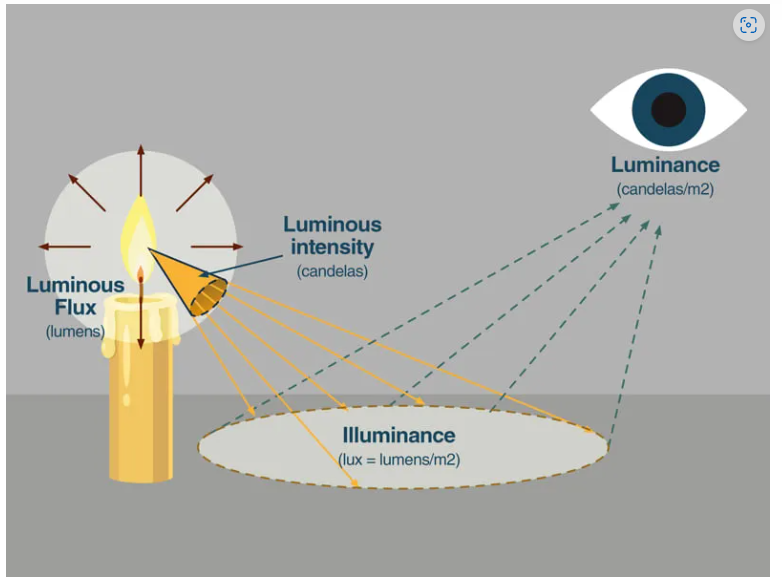
Luminance refers to the ratio of the light intensity of a luminous body to the area of the light source, and is defined as the Luminance of the light source unit, that is, the luminous intensity per unit projection area (Luminance = light intensity ÷ area). The unit of Luminance is candela per square meter (cd/m2). Unlike illuminance, the objective corresponding quantity defined by physics is light intensity. These two quantities are often confused in general everyday language. Luminance is also called Luminance, which indicates the degree of lightness and darkness of a color. The Luminance perceived by the human eye is determined by the light reflected or transmitted by the color.
Luminance is also called light Luminance. It is a numerical value indicating the Luminance of the surface of a light source or a light-receiving object. Luminance is equal to the luminous flux per unit solid angle and per unit projection area leaving, arriving at or passing through a certain surface.
Illuminance:
Illuminance refers to the intensity of light, which indicates the luminous flux of visible light received per unit area, referred to as illuminance, and the unit is lux.
When an object is evenly illuminated by light, when the luminous flux obtained on an area of 1 square meter is 1 lumen, its illuminance is 1 lux. That is: 1lux=1lm/m2.
Since the human eye has different sensitivities to electromagnetic waves of different wavelengths, we cannot directly measure the light energy by the radiation power or radiation flux of the light source. We must use the unit based on the human eye’s perception of light-luminous flux. Luminous flux is represented by the symbol Φ, and the unit is lumen (lm).
Simply put, illuminance is to evaluate the illumination level of visible light on the surface of an object. If the illuminance is too low during color detection, it will make it difficult for us to distinguish the color of the surface of the object.
Concepts related to illumination
Natural illumination and artificial illumination
Sunlight is natural illumination, and lighting is artificial illumination.
Photoperiod and illumination time
In nature, a day and night is a 24-hour photoperiod. The time with light is the light period, and the time without light is the dark period. In natural illumination, the illumination time (light period) is generally calculated based on the sunlight time; in artificial illumination, the time of light exposure is the illumination time, and the 24-hour photoperiod is the natural photoperiod; a period longer or shorter than 24 hours is called a non-natural photoperiod; if there is only one light period and one dark period in 24 hours, it is called single-period illumination; if there are two or more light periods or dark periods in 24 hours, it is intermittent illumination. The sum of the light periods in a photoperiod is the illumination time.
Luminous intensity
The amount of luminous flux transmitted by a light source in a certain direction within a solid angle. Unit: candela (cd).
Luminous flux
The light energy radiated by a light source per unit time is called the luminous flux of the light source, and its unit is lumen (the amount of light on an area of 1 square foot where each point is 1 foot away from a 1-candela light source is 1 lumen).