
With the continuous promotion of the concept of LED environmental protection and energy saving, the domestic LED market is gradually warming up. At the same time, price factors have become a major bottleneck for this development. Domestic manufacturers have reduced costs one after another, and non-isolated power supplies have slowly become the dominant force in the domestic market. When choosing non-isolated power supplies, buyers want to save costs and sellers want to brag about their products, which makes the entire market chaotic.
Fluorescent lamp power supplies are mainly divided into two categories: isolated and non-isolated. The advantages of the isolated power supply isolation solution are its good stability, strong anti-interference ability, and relatively easy to control safety. However, the cost is relatively high. Generally speaking, the output of the isolated power supply The load range is 30-42V. The advantages of a non-isolated power supply are that its efficiency is easy to increase (more than 90%), the overall heat generation is small, the temperature of the power device (MOS tube, power inductor, etc.) can be controlled at around 40 during normal operation, the power is relatively high, and the output adaptability is Strong, the load range can be 30-84V. When choosing a power supply, many LED manufacturers require the power supply to be able to adapt to the full voltage 90-265V input, and the load range is also required to be as high as 84V, for the sake of overall adaptability. Such a choice has certain risks and hidden dangers. This is also an issue that many power supply manufacturers ignore, claiming full voltage input. Most of the non-isolated solutions popular in the market are active PFC primary-side feedback solutions. Most of these solutions are buck topology (BUCK). Typical solutions are (SiLijie, Luda). The other is a passive PFC solution. This type of solution is also a buck topology (BUCK). The typical solution is (Jingfeng, duty cycle). The BUCK circuit is a buck chopper circuit. The average output voltage Uo of the buck topology is always less than the average input voltage Ui. Generally, whether there is continuous current flowing through the inductor mainly depends on the switching frequency, filter inductor and capacitor. Relatively speaking, BUCK circuits usually require a certain voltage difference between the output voltage and the input voltage, which is generally greater than 30V. That is to say, in order to achieve a full voltage of 90-265V input, the output voltage must be below 55V, otherwise there will be only Lighting, abnormal electrical parameters and other safety hazards.
Two typical parameters are selected for comparison below, which can be clearly seen. The experiment chose power supplies from two different companies, one is Juxin Deyuan Technology (JUSIN), and the other is a company with a large shipment volume in the market.
Experiment 1 is a T002A series product of Juxin Deyuan Technology (JUSIN) Co., Ltd. The nominal operating range is AC: 160-265V DC: 30-84V Imax=270mA. The following experiments are for abnormal operating voltage range input states.
Experiment 1
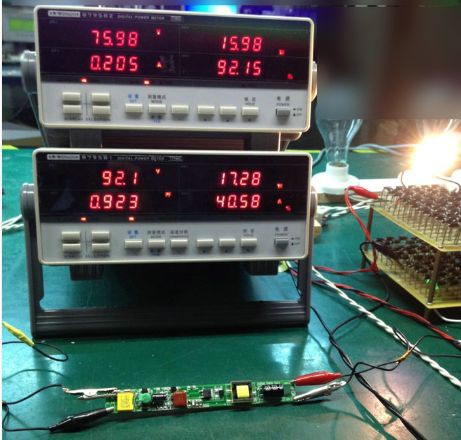
Test record sheet
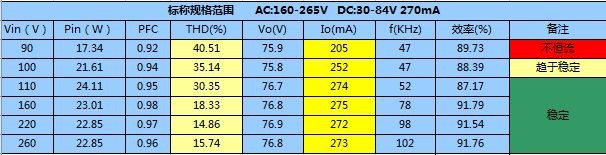
It can be clearly seen from the above test data table that when the power supply is loaded at 76V (24 strings) and the input voltage is 90-110V, THD, current and other parameters have obvious fluctuations. When the power supply is input at 90V The constant current function is lost, the difference from the normal operating current is close to 70mA, and the harmonic current is also as high as 40.51%, which has a great impact on the lumen value of the entire lamp.
Is it due to design factors that cause the above phenomenon? This experiment also found a power supply with similar parameters that has a large market share. The scheme is also a BUCK circuit. The nominal working range of this power supply is AC: 90-265V DC: 30-84V Imax=280mA. Experiment 2 is the nominal working range of this power supply. Test data within range
Experiment 2
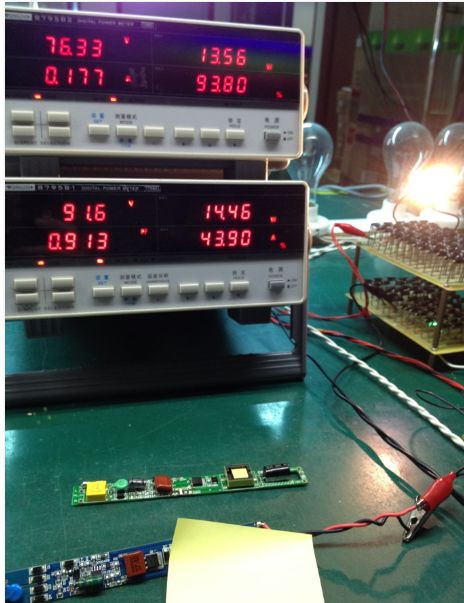
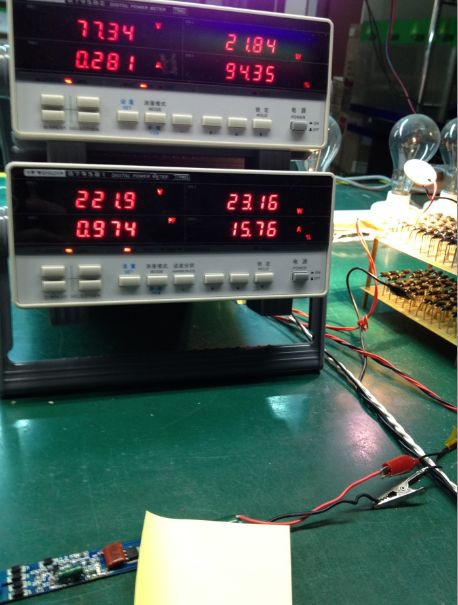
Test Data
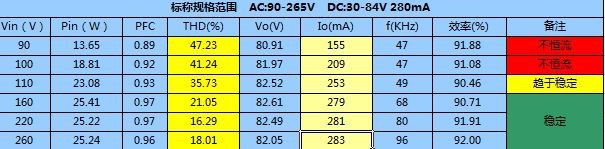
Since then, the actual measured data clearly reflects that when the load is 82V (24 strings) and the input voltage is 90-110V, the hidden dangers mentioned in Experiment 1 also exist. If some power supply manufacturers use inductors in order to reduce costs, If EPC13 is used, there will be safety hazards such as core saturation after the temperature is too high.
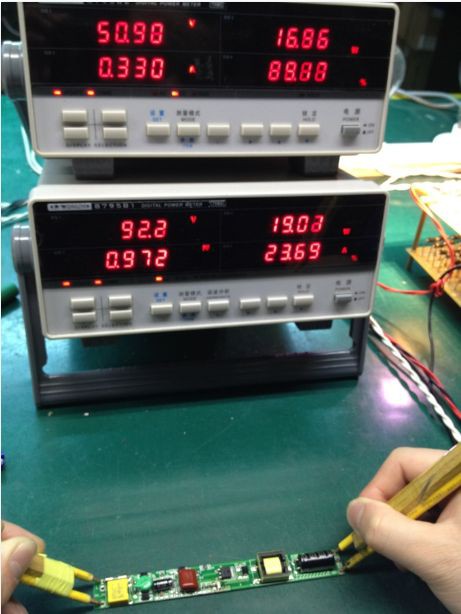
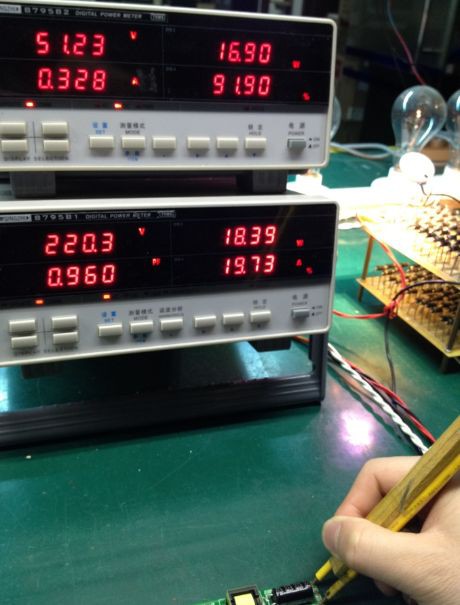
Under what circumstances can this type of BUCK circuit truly meet the full voltage input? Experiment 3 is the T002B series product of Juxin Deyuan Technology. The nominal working range is AC: 90-265V DC: 30-52V Imax=330mA
Experiment 3
Test Data
It can be seen from the above experiments that when the load voltage is 52V, the power supply can reach the required values within the full voltage range.
Through the above three experiments, it can be concluded that when choosing a non-isolated power supply, you should first ask the power supply manufacturer what type of solution the power supply is. If it is a BUCK step-down solution, you must choose carefully. When full voltage input is required, There must be a voltage difference greater than 30V between the load voltage and the minimum input voltage. Due to the lack of experience in power supply testing by some lighting companies, this has resulted in a confusing situation where they only look at whether it can light up and not the electrical parameters, resulting in a certain delay in shipment. Later, the adverse effects of power supply damage frequently appeared on the client side. We hereby call on all LED industry practitioners to adhere to the principle of quality first, truly realize the advantages of LED environmental protection and energy saving, and ultimately promote the healthy and sustainable development of the industry and benefit society!