
What is an integrating sphere?
An integrating sphere is an optical instrument used to measure the total luminous flux or radiant power of light emitted by a light source. It is a hollow sphere coated with a high-reflectivity diffuse reflective material. The internal surface of the integrating sphere will reflect the incident light multiple times and evenly distribute the light energy in the sphere, so that the light energy in all directions is evenly mixed. This evenly distributed light can be captured by the detector and used to calculate the various optical parameters of the light source. Integrating spheres are mainly used to measure total luminous flux, spectral distribution, radiant power, etc.
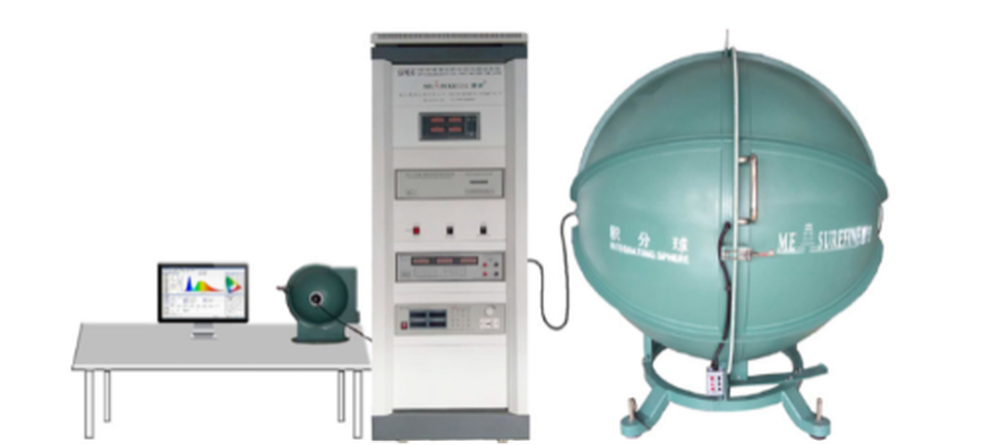
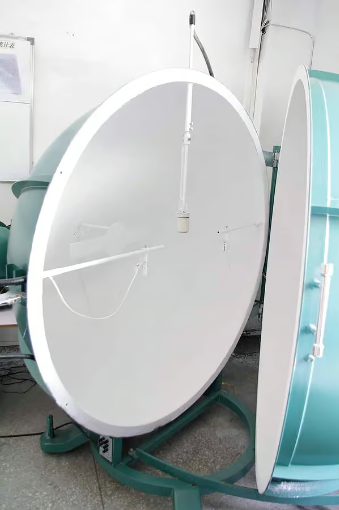
Integrating spheres are also available in many specifications, the most commonly used ones are 0.3M, 1.5M, 2.0M, 2.5M and 3M, and there are also special constant temperature integrating spheres for testing different lamps.
Test method:
After the electrical wiring is connected, install the lamp in the integrating sphere, and perform system calibration before the first test (operation on the software);
Select automatic integration time, directional LED lamps, select the 2π test method for the integrating sphere, and select the 4π method for non-directional LED lamps;
Preheat the lamp under test in the integrating sphere for 10 minutes (can be set directly on the test software), and the system will automatically obtain the light, color and electrical parameters of the lamp after ten minutes;
d) The precision AC and DC power supply provides the rated voltage or current;
Test Objects:
LED chips,LED modules,LED light sources,LED luminaires
Test Parameters:
Optical Parameters:
Relative spectral power distribution,Chromaticity coordinates,Correlated color temperature (CCT),Color tolerance
Luminous flux,Color Rendering Index (CRI),Color Quality Scale (CQS),Peak wavelength,Dominant wavelength
Color purity
Electrical Parameters:
Voltage,Current,Power,Power factor,Frequency
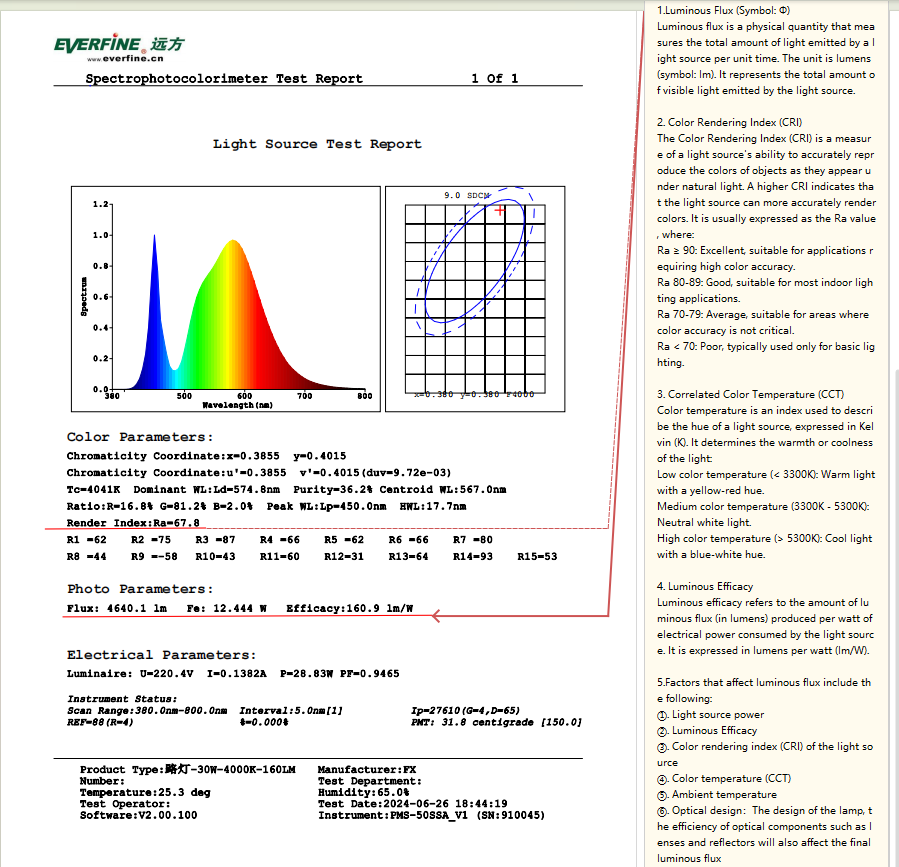
1.Luminous Flux (Symbol: Φ)
Luminous flux is a physical quantity that measures the total amount of light emitted by a light source per unit time. The unit is lumens (symbol: lm). It represents the total amount of visible light emitted by the light source.
2. Color Rendering Index (CRI)
The Color Rendering Index (CRI) is a measure of a light source’s ability to accurately reproduce the colors of objects as they appear under natural light. A higher CRI indicates that the light source can more accurately render colors. It is usually expressed as the Ra value, where:
Ra ≥ 90: Excellent, suitable for applications requiring high color accuracy.
Ra 80-89: Good, suitable for most indoor lighting applications.
Ra 70-79: Average, suitable for areas where color accuracy is not critical.
Ra < 70: Poor, typically used only for basic lighting.
3. Correlated Color Temperature (CCT)
Color temperature is an index used to describe the hue of a light source, expressed in Kelvin (K). It determines the warmth or coolness of the light:
Low color temperature (< 3300K): Warm light with a yellow-red hue.
Medium color temperature (3300K – 5300K): Neutral white light.
High color temperature (> 5300K): Cool light with a blue-white hue.
4. Luminous Efficacy
Luminous efficacy refers to the amount of luminous flux (in lumens) produced per watt of electrical power consumed by the light source. It is expressed in lumens per watt (lm/W).
5.Dominant wavelength
The wavelength of a sample color that is matched by mixing a certain spectral color with a certain standard illuminant in a certain proportion is the dominant wavelength of the sample color.
6.Luminous flux color ratio:
RGB is red, green and blue, and the value refers to the ratio of these three colors in the light source.
7.Peak wavelength:
Usually, a beam of light we see is not just a single wavelength of light, but a combination of many wavelengths of light, and the light with the largest wavelength energy is the peak wavelength of the beam of light.
8.Color purity:
Monochromatic light is the color with the highest color purity. The more white light penetrates into it, the lower the color purity.
9.Light radiation power:
The radiation energy (W) of all wavelength components emitted per unit time.
*Factors that affect luminous flux include the following:
1. Light source power
The greater the power of the light source, the greater the luminous flux it usually produces
Luminous Efficacy
The higher the luminous efficiency, the greater the luminous flux produced at the same power
Color rendering index (CRI) of the light source
The color rendering performance of the light source will affect its spectral distribution
Color temperature (CCT)
Light sources with different color temperatures have different spectral distributions.
Ambient temperature
The operating temperature of the light source will affect its performance. Semiconductor light sources such as LEDs will reduce efficiency in high temperature environments, thereby reducing luminous flux. 8. Optical design The design of the lamp, the efficiency of optical components such as lenses and reflectors will also affect the final luminous flux