
Background (Baidu netizen):
Hello, seniors and experts.
Recently, we are promoting residential corridor lights and replacing them with energy saving. I encountered a problem. I used to use a voice-activated switch in the corridor with two external incandescent bulbs. Now I have replaced it with LED. I learned before that it is not compatible.
The trial situation is,
1: Conventional 85-265V wide voltage LED bulb (3*1W). When the light is on, the two bulbs light up normally. When the light is off, one bulb keeps flashing and the other one is completely off.
2: The 220V-260V voltage LED light (SMD 2W) flickers slightly when the light is on, but cannot be completely extinguished when the light is off, and is in a slightly bright state. .
Excuse me, without replacing the voice-activated switch, how can I improve the LED power supply to make it compatible? Because the quantity is relatively large, it is difficult for customers to accept switch replacement.
Thank you everyone, please give me some advice.
Why I wrote this post:
Not only voice-activated switches, but also touch, human body infrared, and radar induction switches. If the LED power supply can be improved to make it compatible, these smart switches can be used for a second time, which can save consumers a lot of RMB. After all, a smart switch also requires 10-30 yuan.
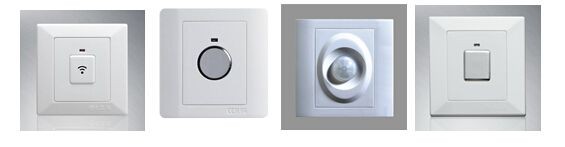
Theme:
1. Principle of intelligent control switch:
The principles of touch, human body infrared, and radar sensor switches are all the same, represented by sound and light control:
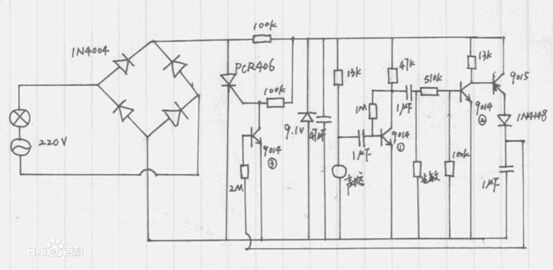
Photosensitive part
It can be seen from the circuit schematic diagram that when it is daytime or when the brightness is greater than a certain level, the resistance of the photoresistor is very small, so for the photosensitive branch, it is equivalent to directly grounding, which is equivalent to connecting the following circuit and If the previous circuit is isolated, the transistor ② will always be in a cut-off state. The unidirectional thyristor will not conduct without triggering current, and the circuit will not work. When there is no light in the dark, the photoresistor shows a high resistance state and does not affect the signal transmission between the transistor ① and the transistor ②. At this time, the voice control part can play a role.
Voice control part
When a sound with sufficient signal is introduced, the voice control part converts the sound signal into an electrical signal, and amplifies the signal through the triode ①, so that the signal is large enough to trigger the triode ②. The conduction of transistor ② reduces its collector level voltage, thus causing transistor 9015 to conduct, and the current passes through diode 1N4148 to transistor ③, and also charges the capacitor. When the transistor ③ is turned on, the unidirectional thyristor PCR406 gets a current that can make it turn on. When the one-way thyristor is turned on, the light can brighten normally.
When the sound signal disappears, the diode is cut off, and the triode ② and the triode 9015 no longer work. However, through the discharge of the capacitor, the triode ③ can still conduct for a period of time, and can also provide current to the one-way thyristor. Such a delay will not cause the light to turn off when the signal disappears, but it is highly practical. When the capacitor is discharged, the circuit returns to the time when there was no signal at the beginning. When the sound signal comes in again, the above situation is repeated.
This part is excerpted from Baidu Encyclopedia Voice Control Switch
http://baike.baidu.com/view/2442754.htm?fr=aladdin
2. Reasons why LED lights are incompatible:
A typical type A bulb is purely resistive. When the thyristor is turned off, the bulb does not light up, but current flows through the bulb. Because voice control, light control, mains electricity and the bulb will form a loop, it is because of this loop that the voice control signal will be converted into an electrical signal. The LED driver is actually a current source, and its input terminal is very capacitive for the intelligent controller and cannot provide a stable loop for sound and light control. Various strange phenomena will appear: constantly turning off when turned off; always on; slightly bright… There are also general voice-activated switches that use electronic circuits with small power, and the current is rectified and waveform attenuated in the voice-activated switch. , when the waveform is rectified through the rectifier again, the waveform will be incomplete, so it will flicker, which is also not conducive to the service life of energy-saving lamps and LED lamps.
Intelligent control switches now involve many microcontrollers and timer ICs to control them. In the same way, when the thyristor is turned off, a stable circuit needs to be provided to power the microcontroller and timer IC, about 5V.
3. How to improve the LED power supply to make it compatible:
First, improve the IC control method to convert the LED power supply from a capacitive load to a resistive-like load.
Secondly, it is necessary to provide the circuit required for intelligent control;
In order to solve the above problem of LED power supply being incompatible with intelligent control switches, Juxin Deyuan Technology has developed a bulb power supply Q002 for the renovation of existing corridors, which is well compatible with infrared, voice control, touch and other intelligent control switches. Currently there are 3W and 5W, which have been mass produced and won unanimous praise from customers.