
Ⅰ. Microwave Sensing
5.8G microwave radar sensing and other sensing technologies are a special distance/displacement measurement method that can solve the measurement problem of short-range targets, so they are also called short-range radars. It has expanded from the military field to the civilian field and has been applied in position measurement, character recognition, speed measurement, environmental monitoring, displacement monitoring, etc.
Compared with other sensing technologies, 5.8G radar sensing technology has unique advantages such as non-contact and resistance to rain, fog and dust, and has gradually become an important sensing method in the field of short-range target displacement measurement.
It is widely used in products such as induction lighting, security, small household appliances, smart homes, automatic door control switches, welcome devices, as well as places such as garages, corridors, stairways, courtyards, balconies, and toilets that require automatic sensing control.
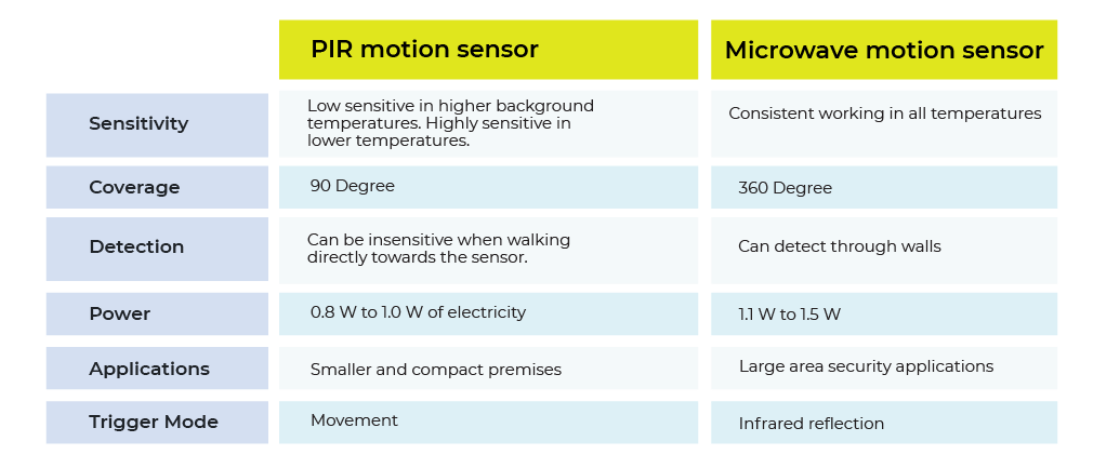
Compared with infrared sensing modules, the sensing distance is farther and the angle is wider, there is no dead zone, and the lens and lens aging problems are not affected by temperature, humidity, airflow, dust, noise, brightness, etc. It has strong anti-interference ability and can penetrate acrylic, glass and thin non-metallic materials. Onboard MCU, embedded with multiple digital filtering algorithms, has higher anti-interference.
Since the chip has integrated 5.8G microwave circuit, intermediate frequency amplifier circuit and signal processing MCU, there are few peripheral components, high integration and good production consistency, which greatly reduces the overall size while ensuring the performance of the sensor.
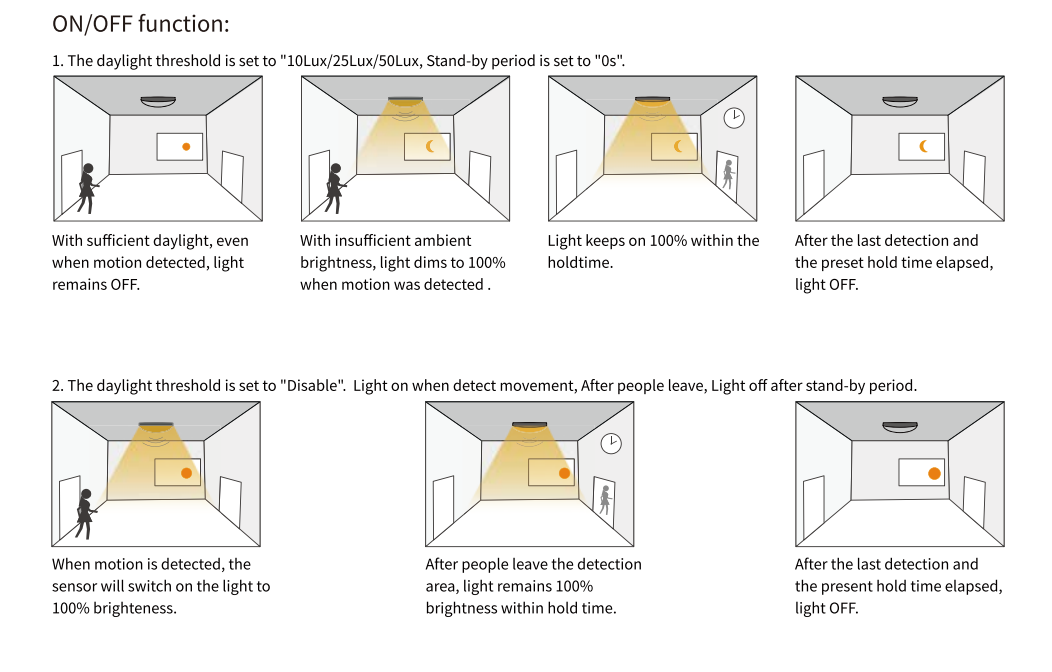
Microwave radar sensors can be used to detect the presence of human body or mobile target sensing in various scenarios, including smart home, Internet of Things and smart lighting, especially in the home appliance and bathroom market, it can be used to realize screen wake-up and gesture control functions, and is widely used because of its high cost performance.
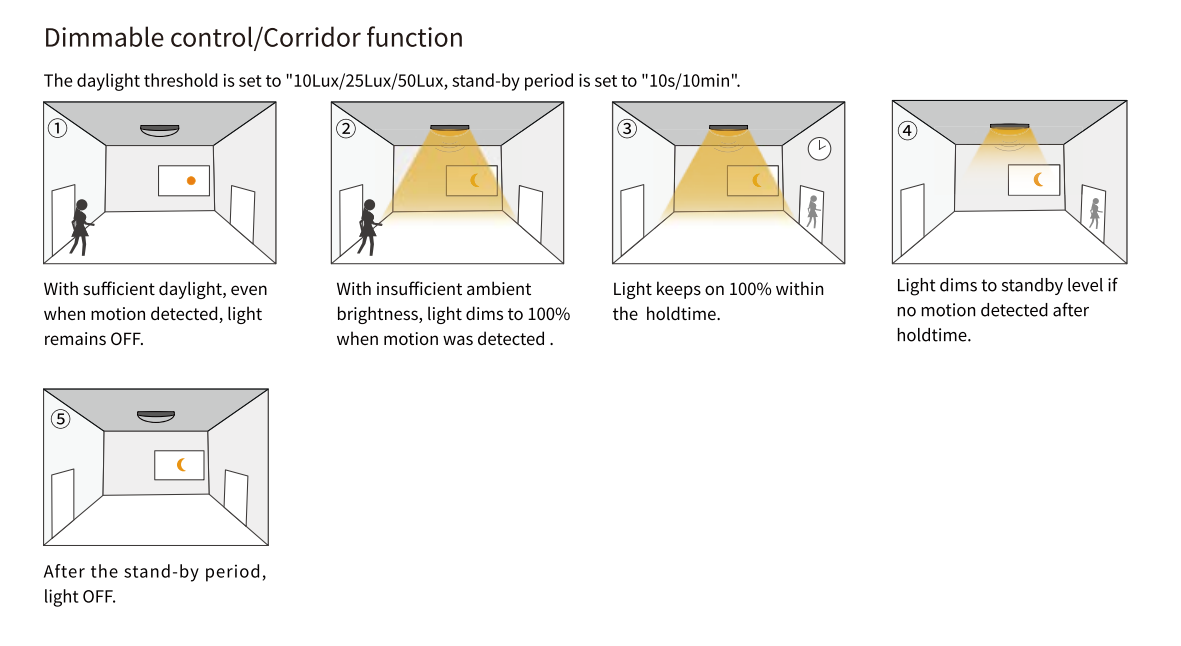
The radar sensing distance can be configured through MCU, and its maximum sensing distance is up to 12 meters. The actual sensing distance can be flexibly adjusted according to needs.
Ⅱ. Basic principle of PIR
1. PIR pyroelectric infrared sensor: referred to as PIR (Passive Infra-Rey)
Composition: mainly composed of housing (Fresnel lens) + pyroelectric probe (filter + pyroelectric element PZT + field effect tube FET) + signal amplification processing unit.
2. Working principle: The human body will emit infrared rays of about 10μm at 37°C, which will be enhanced by the Fresnel filter and concentrated on the infrared sensing source. Infrared sensing sources usually use pyroelectric elements. When receiving the temperature change of human infrared radiation, this element will lose charge balance and release charge to the outside. The subsequent circuit can generate an alarm signal after detection and processing.
This probe is aimed at detecting human radiation.
Therefore, the pyroelectric element must be very sensitive to infrared radiation with a wavelength of about 10μm. In order to be sensitive only to infrared radiation, its radiation surface is usually covered with a special Fresnel filter, so that the interference of the environment is significantly controlled.
3. Fresnel lenses have two forms: refractive and reflective.
Its function is to filter and focus, refract (reflect) the pyroelectric infrared signal on the PIR; the second is to divide the detection area into several bright and dark areas, so that the moving objects entering the detection area can generate a changing pyroelectric infrared signal on the PIR in the form of temperature change, so that the PIR can generate a changing electrical signal.
Passive infrared probe, whose sensor contains two pyroelectric elements connected in series or in parallel.
Moreover, the polarization directions of the two electrodes are just opposite, and the background radiation has almost the same effect on the two pyroelectric elements, causing the pyroelectric effects to cancel each other out, so the detector has no signal output. Once a person invades the detection area and moves horizontally, the infrared radiation of the human body is focused by part of the mirror and received by the pyroelectric element. However, the heat received by the two pyroelectric elements is different, and the pyroelectricity is also different, which cannot be offset, and an alarm is generated after signal processing; if it moves radially, its detection ability will be much weaker.